Alexander Andriatis
I'm a postdoctoral researcher in the Environmental Dynamics Laboratory at MIT, where I study ocean turbulence and particle transport. My current work supports understanding the efficacy of marine carbon dioxide removal and the environmental impacts of deep-sea mining. My research spans observational field campaigns using novel instruments, lab studies, and numerical modeling.
I am also a passionate decarbonization advocate and enjoy thinking about solutions for the clean energy transition.
If you'd like to get in touch, send me an email.
See my lab at MIT
Visit my LinkedIn Profile
Projects
Deep-Sea Sediment Monitoring
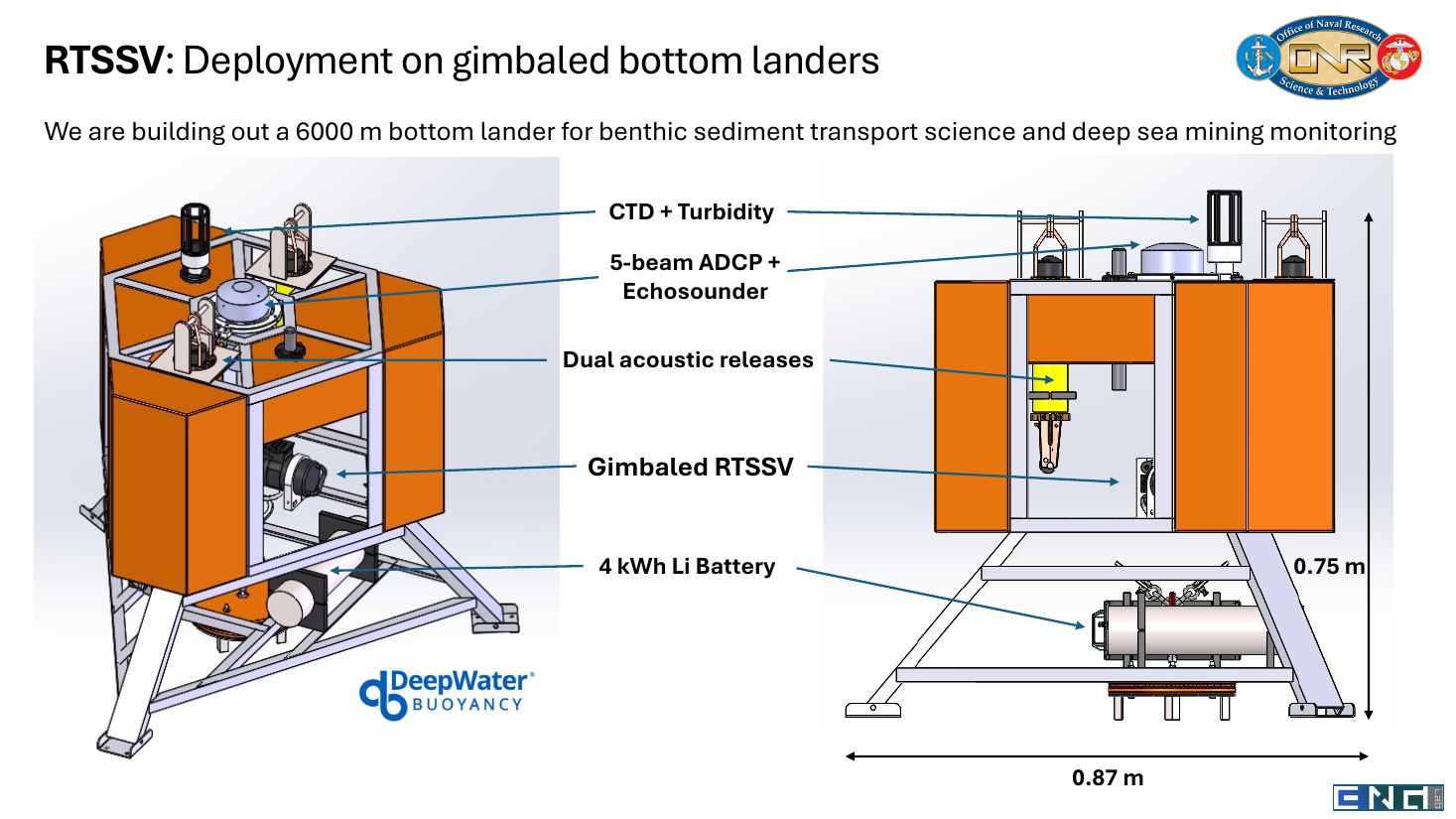
Sediment plumes are at the heart of the environmental impacts of deep-sea mining. Predicting how far a plume spreads requires the size and settling velocity of the suspended particles, which aggregate and break apart in ways that cannot be reproduced by bringing samples to the surface. A prototype of the RTSSV particle camera was previously deployed on collector vehicle trials to observe particle size and shape, and its first field deployment on a gimbaled bottom lander took place in Halifax Harbour in October 2025.
We are building out a bottom lander rated to 6000 m for benthic sediment transport science and deep-sea mining monitoring. It carries the gimbaled RTSSV, a five-beam ADCP with echosounder, a CTD with turbidity sensor, dual acoustic releases, and a lithium battery for month-long deployments.
Presentations
Andriatis, A., T. Peacock, S. El Mousadik, R. Ouillon, and C. Munoz-Royo: An in-situ optical particle size and settling velocity sensor (RTSSV) for deep sea mining monitoring. Impacts of Deep-Sea Mining session, Ocean Sciences Meeting, February 2026.