Alexander Andriatis
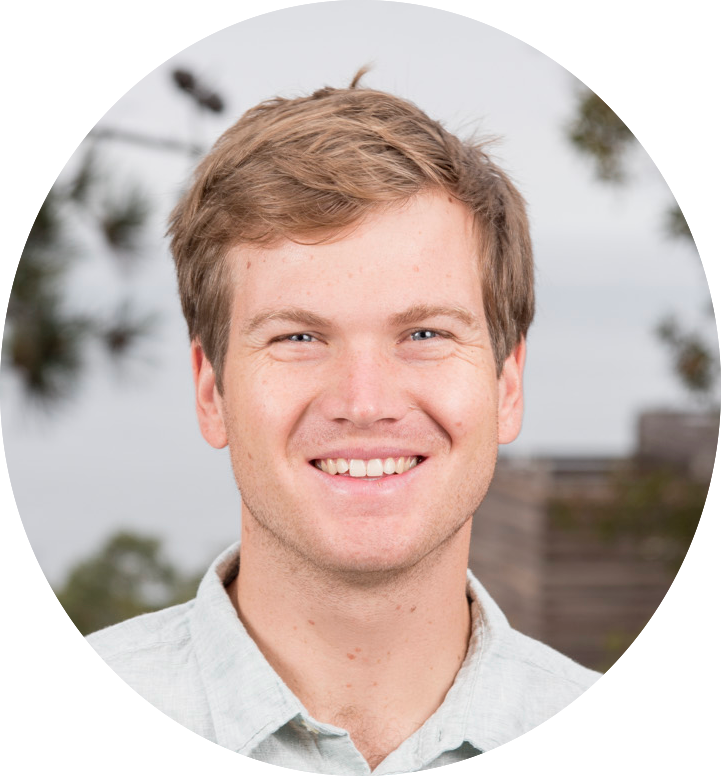
I'm a postdoctoral researcher in the Environmental Dynamics Laboratory at MIT, where I study ocean turbulence and particle transport. My current work supports understanding the efficacy of marine carbon dioxide removal and the environmental impacts of deep-sea mining. My research spans observational field campaigns using novel instruments, lab studies, and numerical modeling.
I am also a passionate decarbonization advocate and enjoy thinking about solutions for the clean energy transition.
If you'd like to get in touch, send me an email.
See my lab at MIT
Visit my LinkedIn Profile
Projects
The RTSSV Particle Camera
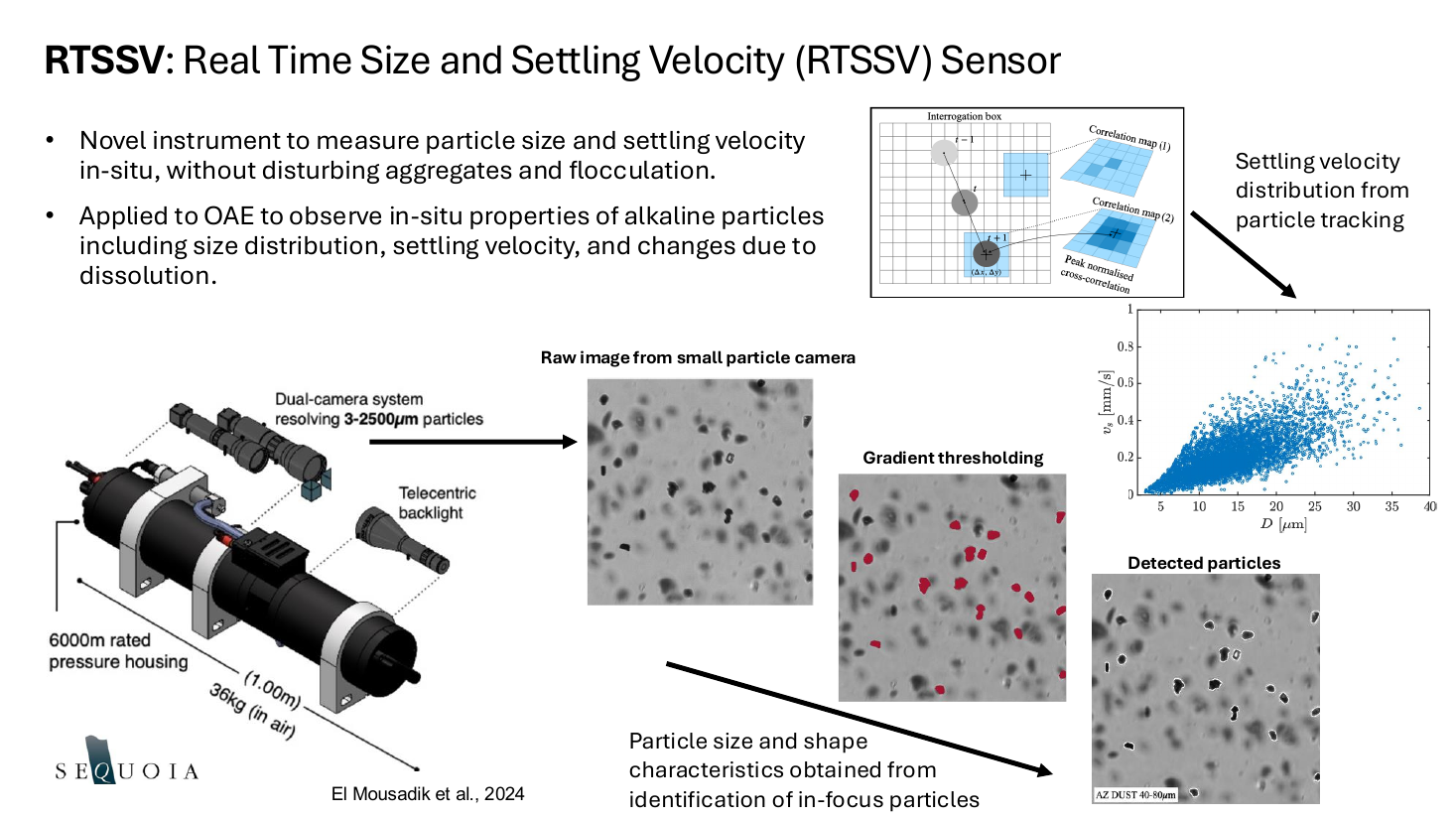
The Real-Time Size and Settling Velocity (RTSSV) instrument, developed in the Environmental Dynamics Laboratory at MIT, measures the size and settling velocity of suspended particles in situ, without disturbing the aggregates and flocs that form in the ocean. Particles settle through an imaging chamber designed to minimize the Boycott effect, a small and a large particle camera resolve different size ranges, and in-focus particles are identified and tracked from frame to frame to recover the settling velocity distribution. The instrument has been validated in the lab for particle size, settling velocity, and suspended sediment concentration (El Mousadik et al., 2024).
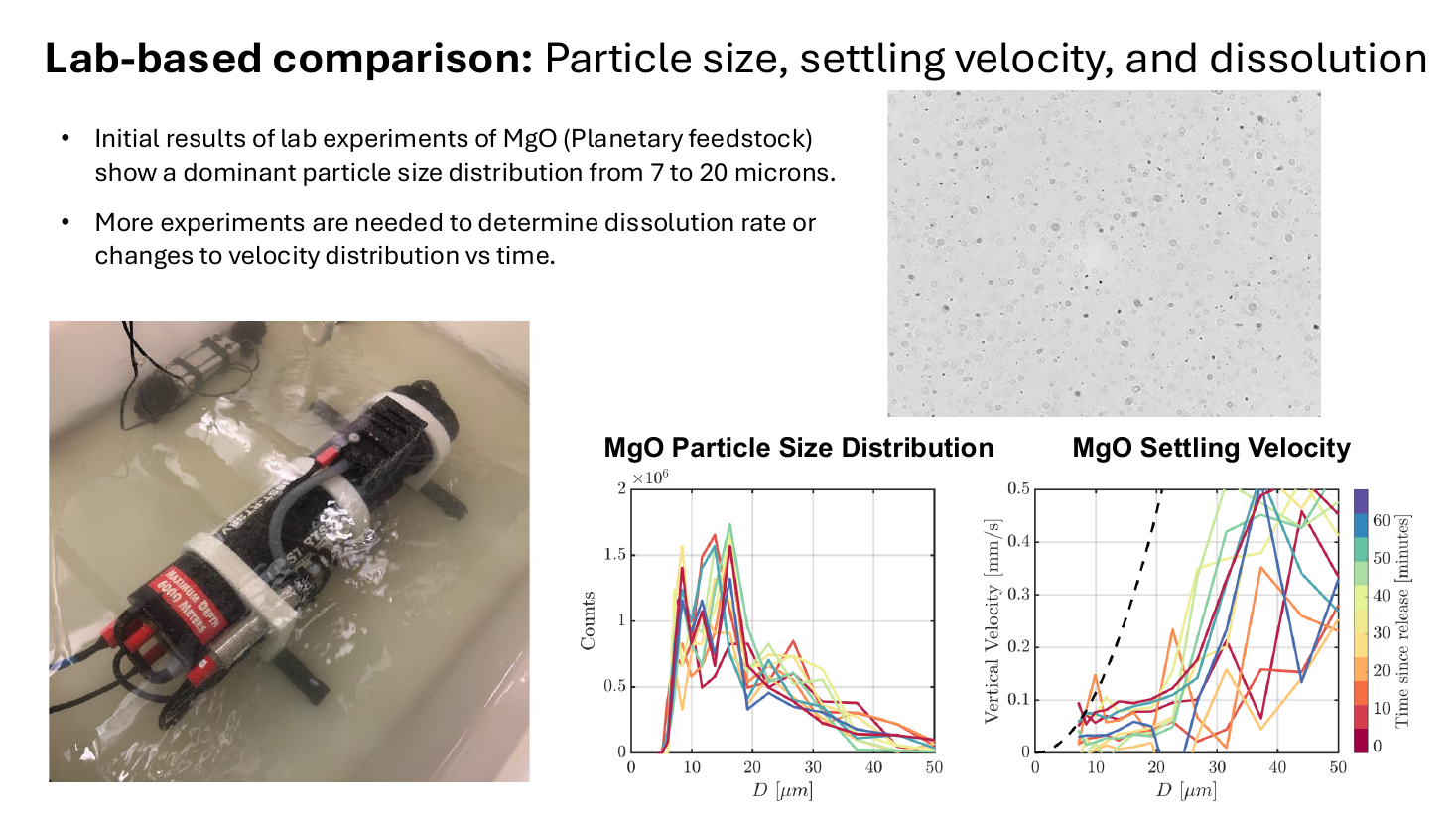
I use the RTSSV in two configurations: on a gimbaled bottom lander for in situ observations, and as an ex-situ chamber fed by a pump whose intake depth can be varied. In the lab I measure the size and settling velocity of candidate feedstocks for ocean alkalinity enhancement. Initial experiments with magnesium oxide show a dominant particle size from 7 to 20 microns, and more experiments are needed to determine dissolution rates and changes in the settling velocity distribution with time. The instrument has been deployed in the field for ocean alkalinity enhancement and is being prepared for deep-sea sediment monitoring.
Presentations
Andriatis, A., T. Peacock, S. El Mousadik, R. Ouillon, and C. Munoz-Royo: An in-situ optical particle size and settling velocity sensor (RTSSV) for deep sea mining monitoring. Impacts of Deep-Sea Mining session, Ocean Sciences Meeting, February 2026.
Get in touch for code and implementation guides.