Alexander Andriatis

I'm a postdoctoral researcher in the Environmental Dynamics Laboratory at MIT, where I study ocean turbulence and particle transport. My current work supports understanding the efficacy of marine carbon dioxide removal and the environmental impacts of deep-sea mining. My research spans observational field campaigns using novel instruments, lab studies, and numerical modeling.
I am also a passionate decarbonization advocate and enjoy thinking about solutions for the clean energy transition.
If you'd like to get in touch, send me an email.
See my lab at MIT
Visit my LinkedIn Profile
Projects
Turbulence at the Base of the Mixed Layer
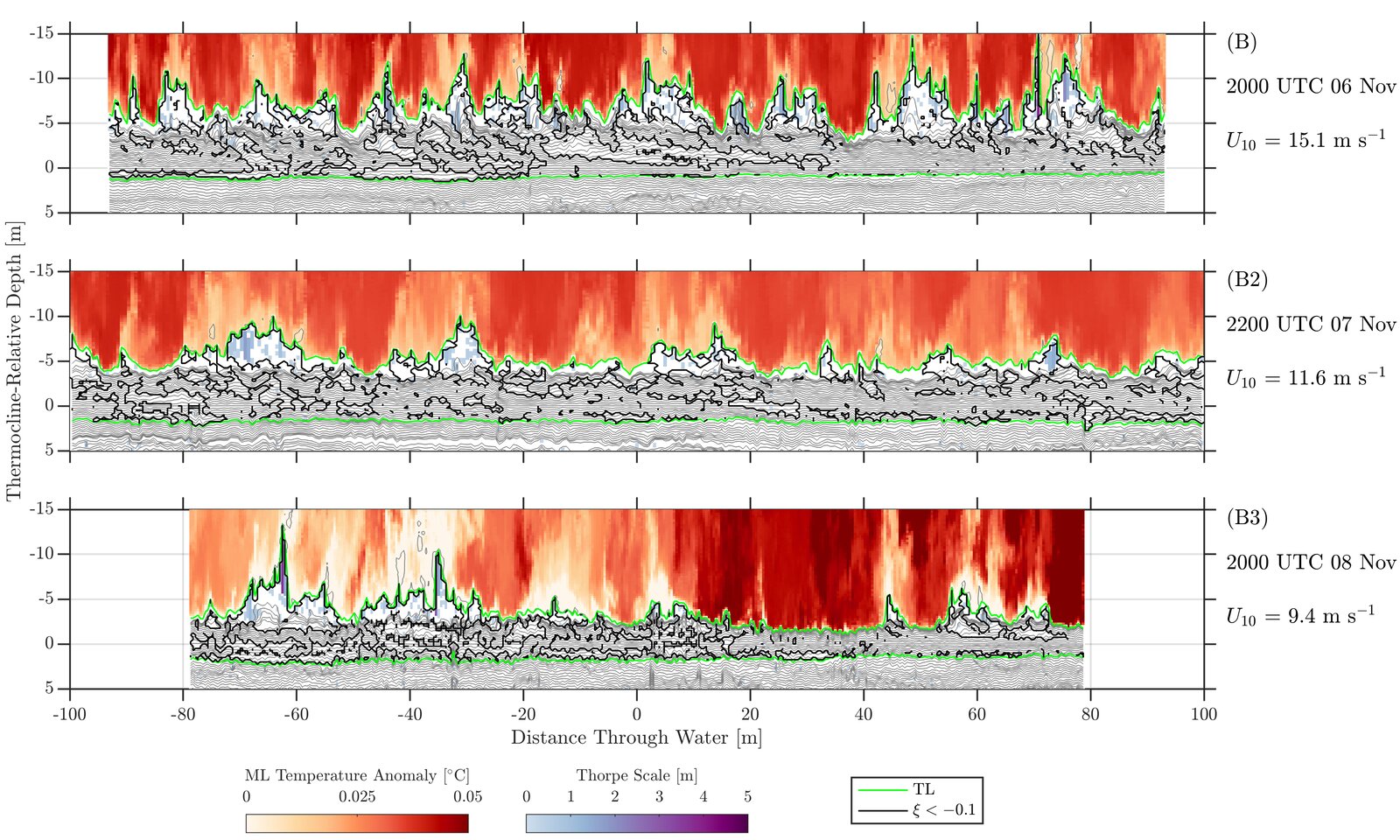
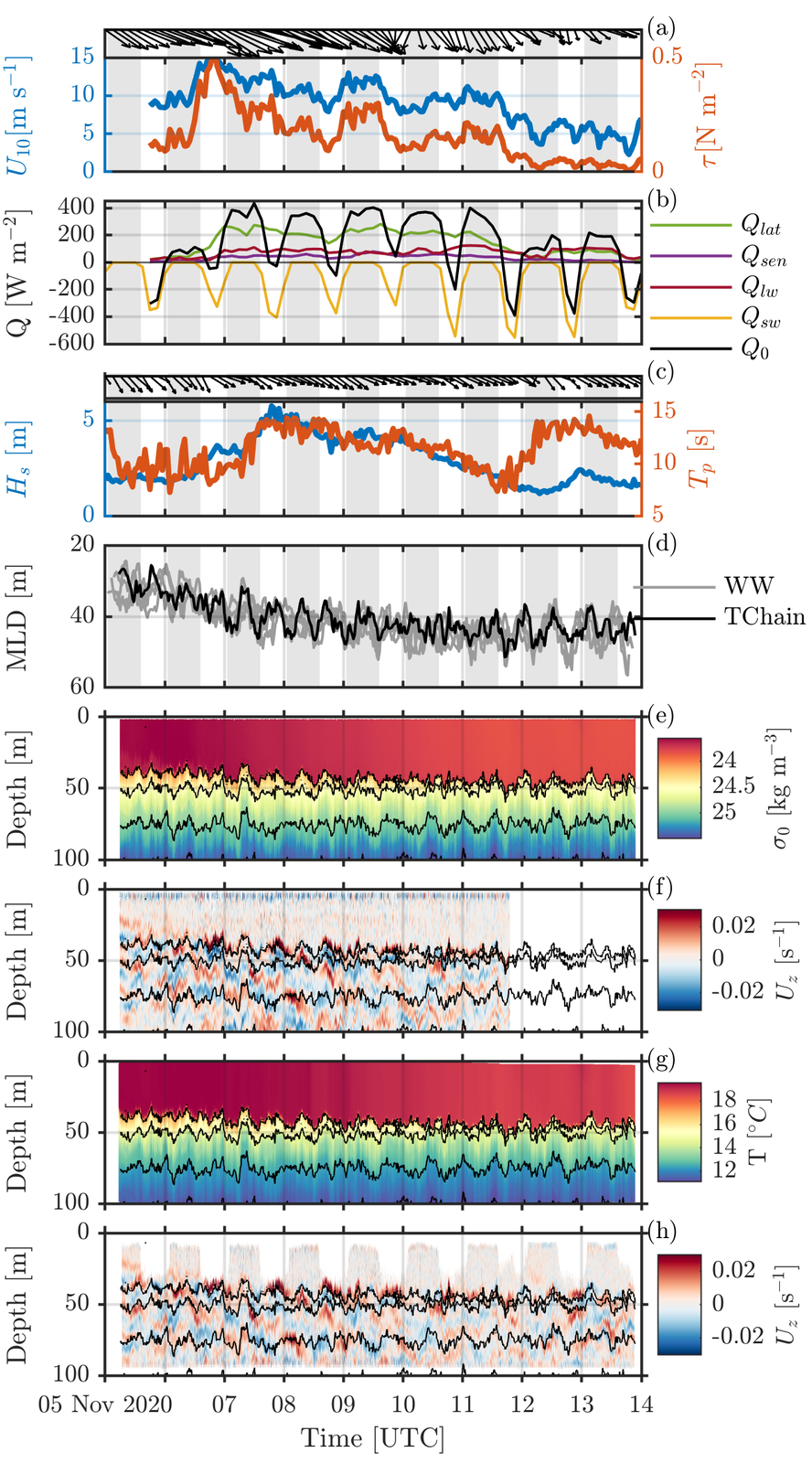
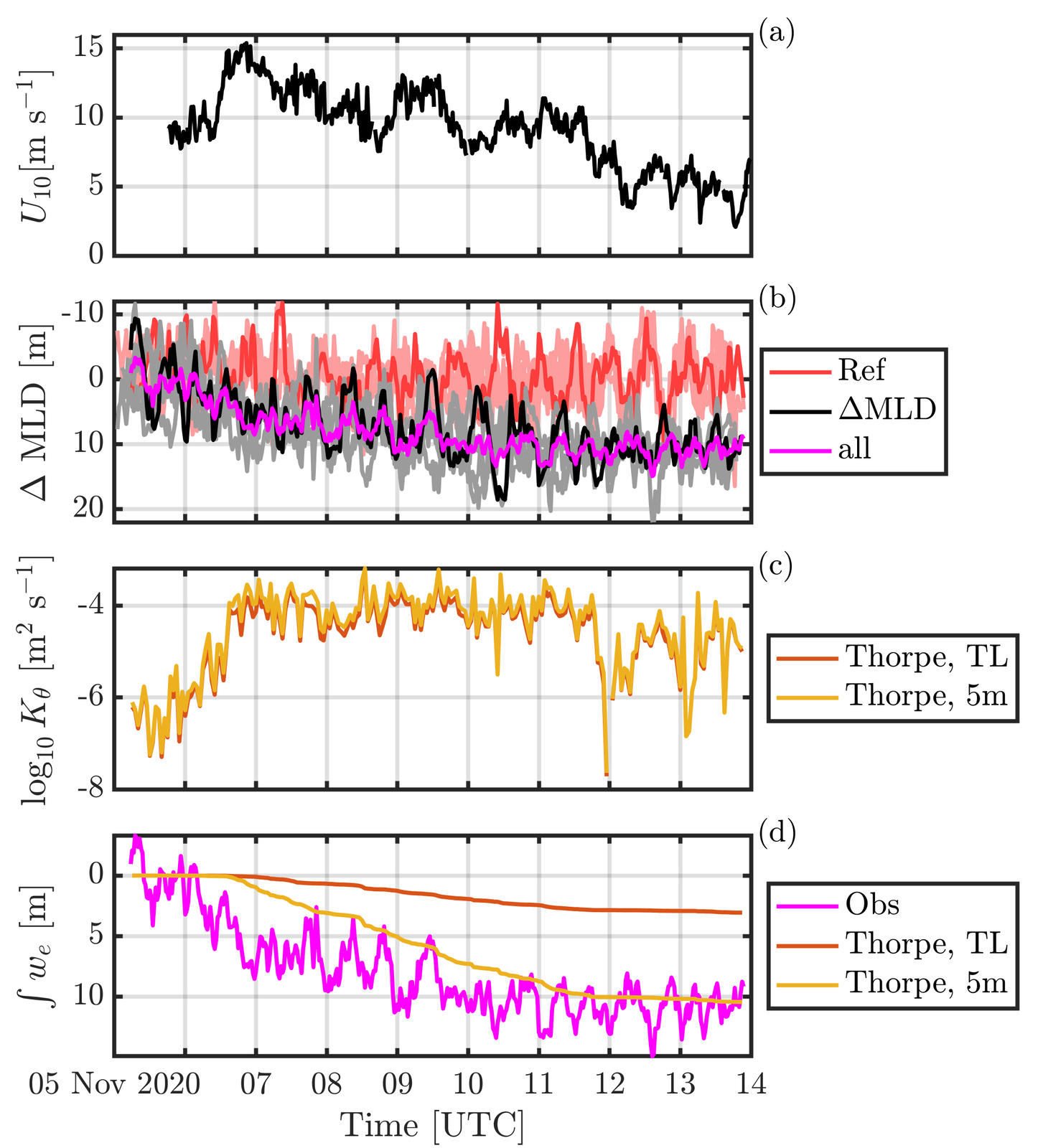
Wind and waves mix the ocean surface boundary layer, and the mixed layer deepens by entraining stratified water from below. The depth of the mixed layer sets the exchange of momentum, heat, and gases such as carbon dioxide between the atmosphere and the ocean, but the turbulent structures that do the entraining are a few meters in size and last minutes, too small and fast for most ocean observations. During the Task Force Ocean experiment in November 2020, we deployed a drifting thermistor chain with 58 sensors spaced as closely as 0.5 m across the base of the mixed layer, together with an array of five drifting Wirewalker profilers, and let the wave-driven heave of the chain sweep the sensors through the transition layer. Over a six-day storm with winds reaching 15 m/s, the chain resolved overturning structures consistent with Kelvin–Helmholtz and Holmboe shear instabilities under four distinct surface-forcing regimes: wind and waves with cooling, wind and waves with weak heating, convection, and a diurnal warm layer. Thorpe-scale estimates of the entrainment flux, restricted to the top of the transition layer, account for the observed deepening of the mixed layer from 35 to 45 m. The results give a direct observational test of how mixed layer deepening is parametrized in ocean and climate models.
Publications
Andriatis, A., M. H. Alford, A. J. Lucas, S. Merrifield, and L. Lenain, 2026: Observations of Turbulent Structures at the Base of the Ocean Mixed Layer. J. Phys. Oceanogr., 56, 2179–2202, https://doi.org/10.1175/JPO-D-25-0169.1
Data and figure scripts: UC San Diego Library Digital Collections